
Knee Pain & Injury Care
Torn ligaments, worn cartilage, a knee that swells or gives way. We diagnose the cause, start with the least invasive fix that will work, and use arthroscopic or robotic-assisted surgery when surgery is the right call.
Signs your knee needs attention
If any of these last more than a couple of weeks, or started with a specific injury, an evaluation can find the cause before a small problem becomes a bigger one.
- Pain on stairs, squatting or kneeling
- Swelling that comes back after activity
- A pop at the time of injury
- The knee buckles or gives way
- Catching, locking or clicking
- Stiffness or loss of full bend or straightening
Common knee conditions
Sports & acute injuries
ACL tear
A partial or complete tear of the ligament that keeps the knee stable when you pivot, cut or land. Common in soccer, basketball and skiing.
Meniscus tear
Damage to the C-shaped cartilage cushions in the knee, often felt as pain, catching or locking.
PCL injury
A tear of the ligament at the back of the knee, usually from a direct blow to the front of the shin.
Multi-ligament injury
Several ligaments injured at once, typically after high-energy trauma. Often needs staged reconstruction.
Knee fracture
Breaks of the kneecap, femur or tibia around the joint from falls or sports collisions.
Knee sports injuries
Sprains, strains and overuse injuries from running, jumping and contact sports.
Chronic & degenerative
Knee osteoarthritis
Gradual wear of the joint surface that causes pain, stiffness and reduced walking tolerance.
Runner's knee
Pain around or behind the kneecap (patellofemoral pain) that flares with stairs, squatting and running.
Cartilage damage
Focal defects in the smooth joint lining that can progress to arthritis if left alone.
Knee swelling
Fluid on the knee that causes tightness and stiffness and usually points to an underlying problem.
Knee instability
Episodes of the knee giving way or buckling, often from ligament damage.
Failed prior surgery
Persistent pain or instability after a previous knee operation, evaluated for revision.
Keep a small problem small
Surgery isn't always the answer. Most patients get better with physical therapy, bracing, medication or injections, and we try those first. When surgery will clearly help, we use minimally invasive and robotic-assisted techniques, and we decide on the plan together with you.
Physical therapy
Targeted strengthening and mobility work, coordinated with your therapist.
Bracing & activity changes
Support and a modified routine while the tissue heals.
Joint injections
Anti-inflammatory injections into the joint to calm pain so rehab can work.
Knee procedures
- Knee arthroscopySmall incisions and a camera to see inside the joint and treat tears, loose bodies and cartilage damage.
- ACL reconstructionRebuilds the ligament with a hamstring, patellar tendon or quadriceps tendon graft chosen for your sport and anatomy.
- ACL revision surgeryRedo reconstruction when a prior ACL graft has failed or the knee is still unstable.
- Meniscus repairStitches the torn cartilage back together to preserve it whenever the tear allows, instead of trimming it away.
- Cartilage restorationMicrofracture, OATS (osteochondral transfer) and MACI cell-based repair for focal cartilage defects.
- Partial & total knee replacementRobotic-assisted replacement of the worn joint surfaces for advanced arthritis.
Knee questions
Do all ACL tears need surgery?
No. Less active patients and some partial tears do well with physical therapy and bracing. Athletes who pivot and cut, and anyone whose knee keeps giving way, usually do best with reconstruction.
Can a torn meniscus heal on its own?
Small tears in the outer edge, where blood supply is good, can heal. Larger tears, or tears that cause locking, often need arthroscopy. Whenever possible we repair the meniscus instead of removing it.
Am I too young for a knee replacement?
Age alone doesn't decide it. We look at pain, function, X-rays and how well other treatments have worked. Cartilage restoration and partial replacement can be options for younger, active patients.
Will I need an MRI?
Many knee problems can be diagnosed with an exam and X-rays. We order an MRI when it will change the treatment plan, such as a suspected ligament or meniscus tear.
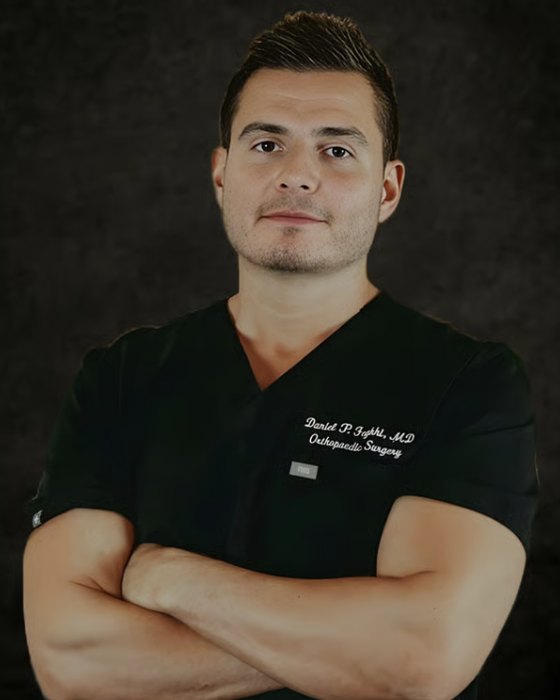
Daniel Feghhi, MD, FAAOS
Having undergone many orthopedic procedures himself, Dr. Feghhi understands the patient experience and strives to restore an active lifestyle for every patient.
Ready to get moving again?
Request an appointment at any of our six New Jersey offices. Our team will call you back to confirm a time.