
Shoulder Pain & Injury Care
The shoulder has the widest range of motion of any joint, which also makes it easy to injure. We treat rotator cuff tears, dislocations, labral tears, frozen shoulder and arthritis, with arthroscopic repair when you need it.
Signs your shoulder needs attention
If any of these last more than a couple of weeks, or started with a specific injury, an evaluation can find the cause before a small problem becomes a bigger one.
- Pain reaching overhead or behind your back
- Night pain, especially lying on the shoulder
- Weakness lifting the arm
- The shoulder slips, pops out or feels loose
- Stiffness and loss of motion
- Clicking, catching or grinding
Common shoulder conditions
Sports & acute injuries
Rotator cuff tear
A tear in the tendons that lift and rotate the arm. Causes night pain and weakness reaching overhead.
Shoulder dislocation
The ball comes out of the socket, often damaging the labrum and leaving the shoulder prone to slipping again.
SLAP tear
A tear at the top of the labrum where the biceps attaches, common in throwers and lifters.
AC joint separation
Injury to the joint where the collarbone meets the shoulder blade, usually from a fall onto the shoulder.
Clavicle fracture
A broken collarbone from a fall, a bike crash or a sports collision.
Shoulder sports injuries
Strains, tendon injuries and instability in throwers, swimmers, lifters and contact athletes.
Chronic & degenerative
Shoulder impingement
Irritated tendons and an inflamed bursa pinched under the acromion when you raise your arm.
Frozen shoulder
Adhesive capsulitis: the joint capsule thickens and tightens, sharply limiting motion.
Shoulder arthritis
Wear of the ball-and-socket joint surfaces, causing deep aching pain and grinding.
Biceps tendinitis
Inflammation of the biceps tendon at the front of the shoulder.
Chronic instability
A loose shoulder that shifts or feels unstable, sometimes after a prior surgery.
Failed prior surgery
Ongoing pain, stiffness or instability after a previous shoulder operation, evaluated for revision.
Keep a small problem small
Surgery isn't always the answer. Most patients get better with physical therapy, bracing, medication or injections, and we try those first. When surgery will clearly help, we use minimally invasive and robotic-assisted techniques, and we decide on the plan together with you.
Physical therapy
Targeted strengthening and mobility work, coordinated with your therapist.
Bracing & activity changes
Support and a modified routine while the tissue heals.
Joint injections
Anti-inflammatory injections into the joint to calm pain so rehab can work.
Shoulder procedures
- Shoulder arthroscopyCamera-guided surgery through small incisions to diagnose and treat problems inside the joint.
- Rotator cuff repairArthroscopic reattachment of torn tendons to bone.
- Shoulder stabilizationBankart repair and capsular tightening to stop repeat dislocations.
- Labral repairArthroscopic repair of SLAP tears and Bankart lesions.
- Shoulder replacementPartial or total replacement for advanced arthritis.
Shoulder questions
Does every rotator cuff tear need surgery?
No. Many partial tears and some small full-thickness tears improve with physical therapy. Surgery is usually recommended for larger tears, tears from a clear injury, and tears that stay weak or painful despite therapy.
I dislocated my shoulder once. Will it happen again?
The risk is highest in young, active patients. After a first dislocation we check the labrum and bone with imaging and talk through whether stabilization surgery makes sense for your sport and goals.
How long does frozen shoulder last?
Frozen shoulder often runs its course over many months. Stretching, therapy and targeted treatment can speed recovery. Surgery is rarely needed.
How long is recovery after rotator cuff repair?
Most patients wear a sling for several weeks, then progress through physical therapy. Full strength typically returns over several months. We give you a timeline based on your specific repair.
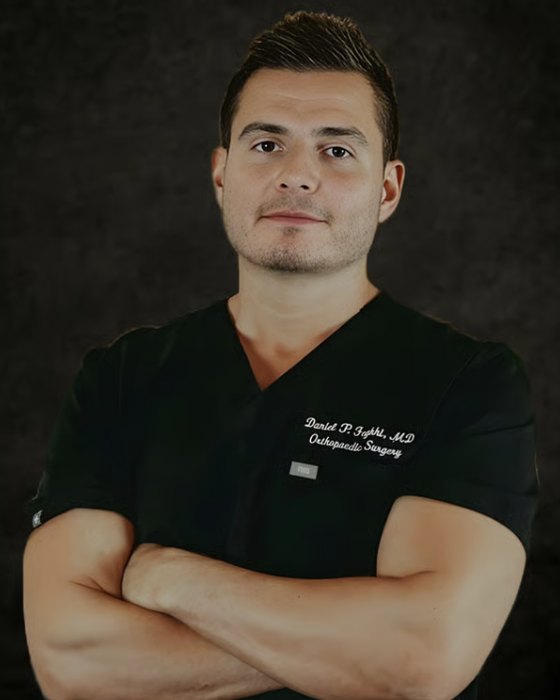
Daniel Feghhi, MD, FAAOS
Having undergone many orthopedic procedures himself, Dr. Feghhi understands the patient experience and strives to restore an active lifestyle for every patient.
Ready to get moving again?
Request an appointment at any of our six New Jersey offices. Our team will call you back to confirm a time.